Architecture
This page is the technical map of AgentGem: how a request flows from a client, through the contract surface, into the framework-agnostic Gem core, and out to archives, targets, the registry, and deploy backends. For the conceptual "why," read Concepts first.
The big picture
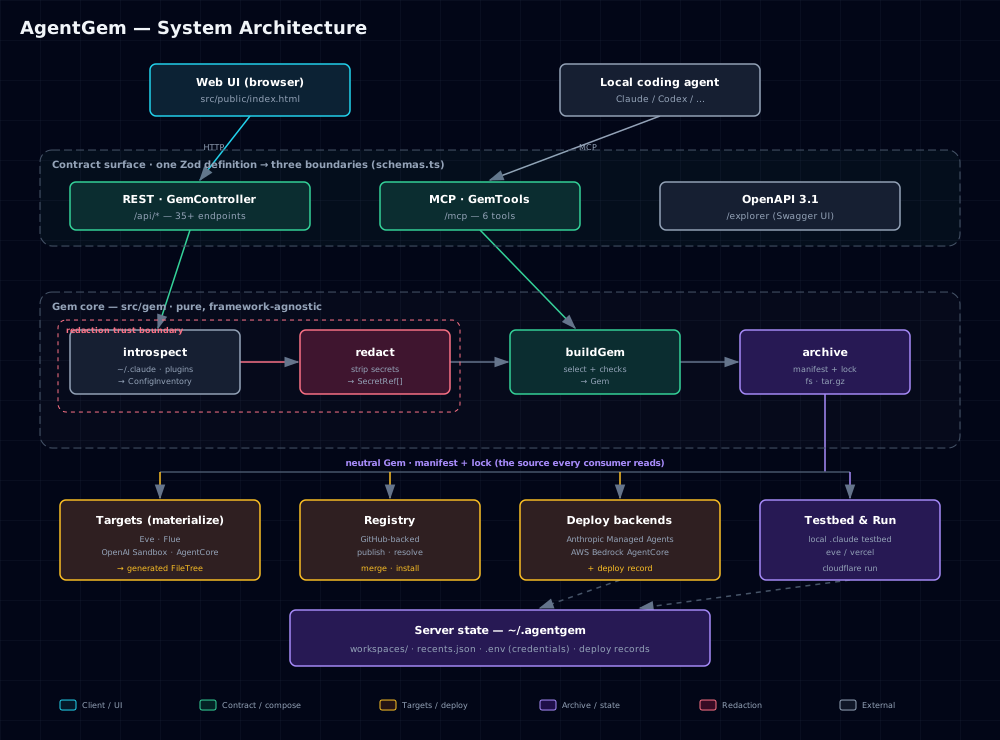
Diagram:
diagrams/system-architecture.svg· PNG · interactive HTML (Copy / PNG / PDF export)
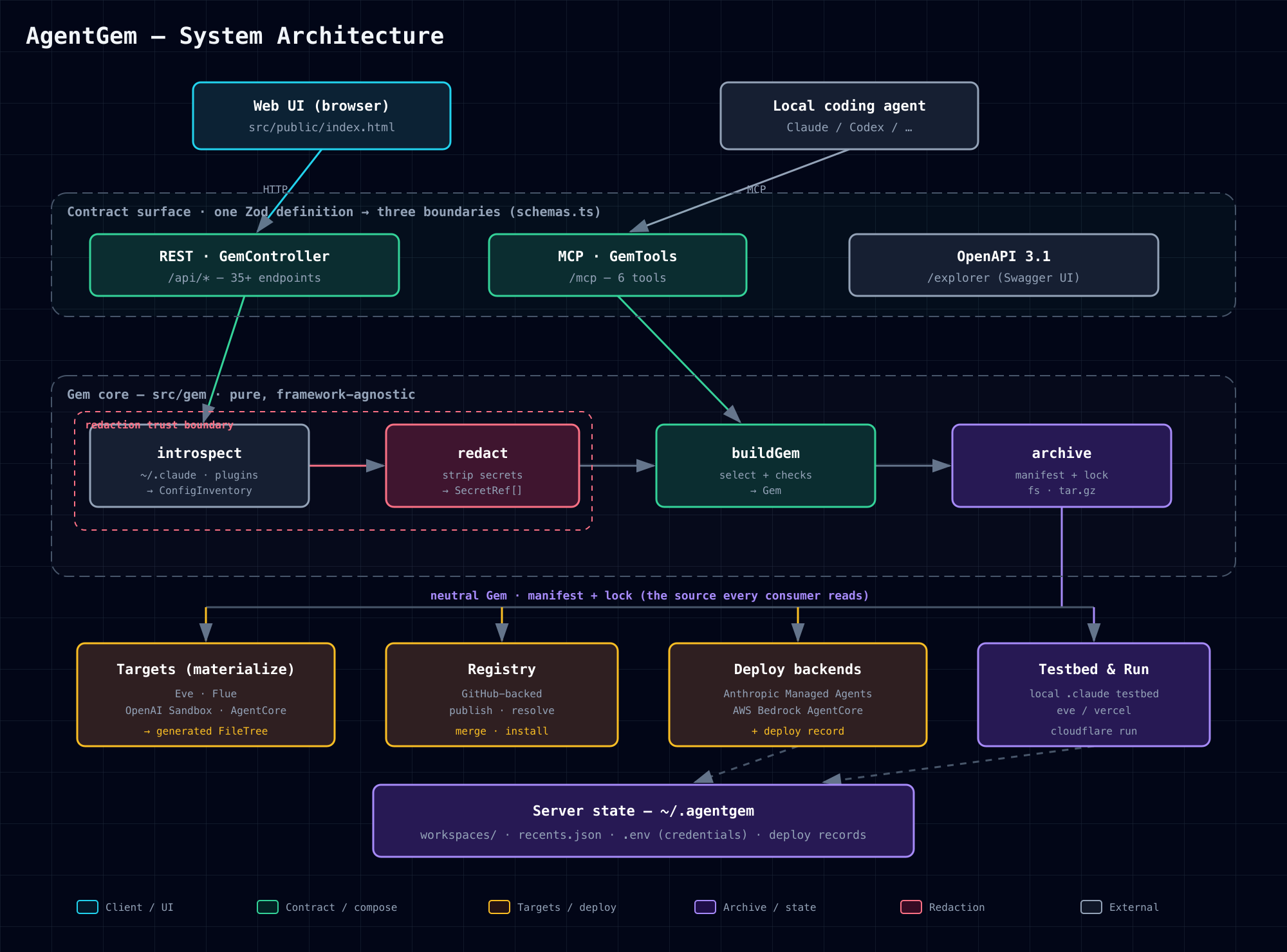
There are four horizontal bands:
- Clients — the web UI (
src/public/index.html) and any local coding agent. - Contract surface — one Zod definition per operation, surfaced as a REST endpoint, an MCP tool, and an OpenAPI 3.1 document. See the one-contract model.
- Gem core (
src/gem/) — pure, framework-agnostic functions:introspect→redact→buildGem→archive. See the build pipeline. - Distribution — the neutral Gem feeds targets (materialize), the registry, deploy backends, and local testbeds/runs. See distribution below.
Server-side state lives under ~/.agentgem (workspaces, recents, credentials, deploy
records) — never inside a Gem.
The one-contract model
AgentGem is built on AgentBack. The entry point src/index.ts wires a single
RestApplication with both an HTTP server and an MCP server:
const app = new RestApplication({});
app.configure("servers.RestServer").to({ port, host: "127.0.0.1" });
app.component(MCPComponent);
app.configure("servers.MCPServer").to({ name: "agentgem", version: "0.1.0", transports: { stdio: false } });
app.restController(GemController);   // REST  → /api/*
app.service(GemTools);              // MCP   → /mcp
await installExplorer(app, { title: "agentgem API" }); // OpenAPI + Swagger → /explorer
await installMcpHttp(app);
| Boundary | Surfaced by | Path | Notes |
|---|---|---|---|
| REST | GemController (@api) |
/api/* |
35+ endpoints; the stateful surface (workspaces, deploy, publish) |
| MCP | GemTools (@mcpServer) |
/mcp |
6 tools; read + plan operations for agents |
| OpenAPI / Swagger | installExplorer |
/explorer |
Derived from the same Zod schemas |
| Web UI | Express route | / |
Serves the single-page builder |
REST and MCP are not parallel re-implementations: both call the same helper functions
(e.g. introspectAll, buildGem) and validate against the same schemas in
src/schemas.ts. The REST surface simply adds the stateful operations (workspace CRUD,
run, deploy, publish) that a UI needs; MCP focuses on the read-and-plan operations an agent
needs. See the full list in the API reference.
Because every operation is decorator-defined, the build must compile with
experimentalDecorators + emitDecoratorMetadata — see Development.
The Gem core
Everything under src/gem/ is framework-agnostic — no HTTP, no decorators, just functions
over plain data. That is what lets the same code back a web request, an MCP tool call, and
a test. The pipeline is documented in detail in The build pipeline; the
on-disk result is specified in Archive format; the safety rule that
governs all of it is in Redaction.
| Module | Responsibility |
|---|---|
introspect.ts |
Read ~/.claude, plugins, ~/.agents, ~/.codex, ~/.hermes, and project dirs into a ConfigInventory |
redact.ts |
Strip secret values at capture; record SecretRef[] |
buildGem.ts |
Select artifacts by name → a Gem (+ checks, requiredSecrets) |
archive.ts |
Lay a Gem out as gem.json (manifest) + gem.lock and verify integrity |
archiveFs.ts / archiveTar.ts |
Serialize the file tree to a directory or a deterministic .tar.gz |
checks.ts |
Scaffold behavioral + external (skillspector) checks |
types.ts |
The core types: Gem, GemArtifact, ConfigInventory, GemCheck, … |
Distribution
The Gem is a neutral source. Three subsystems consume it, plus local testbeds and runs.
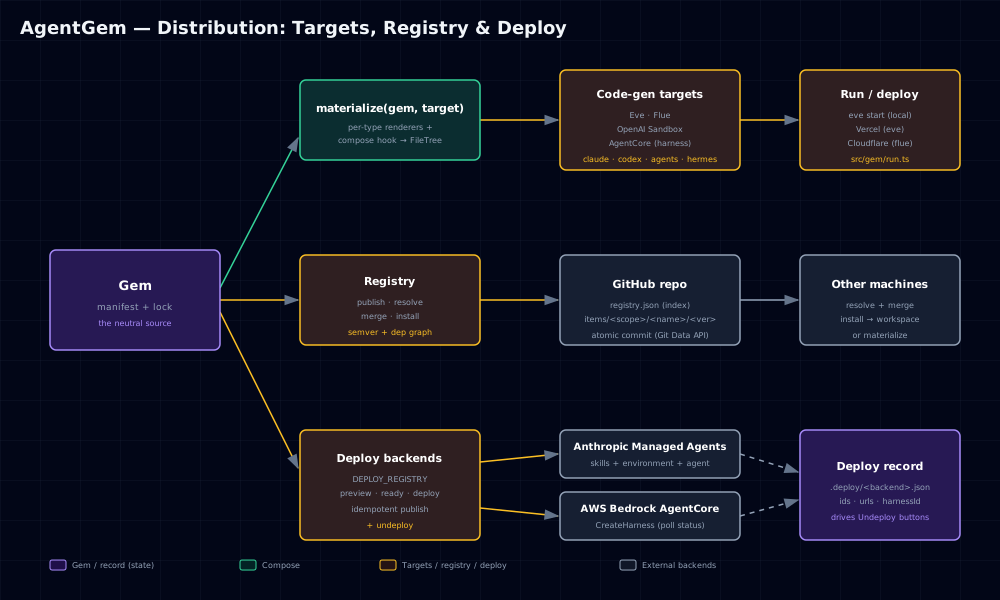
Diagram:
diagrams/distribution.svg· PNG · interactive HTML
- Targets (
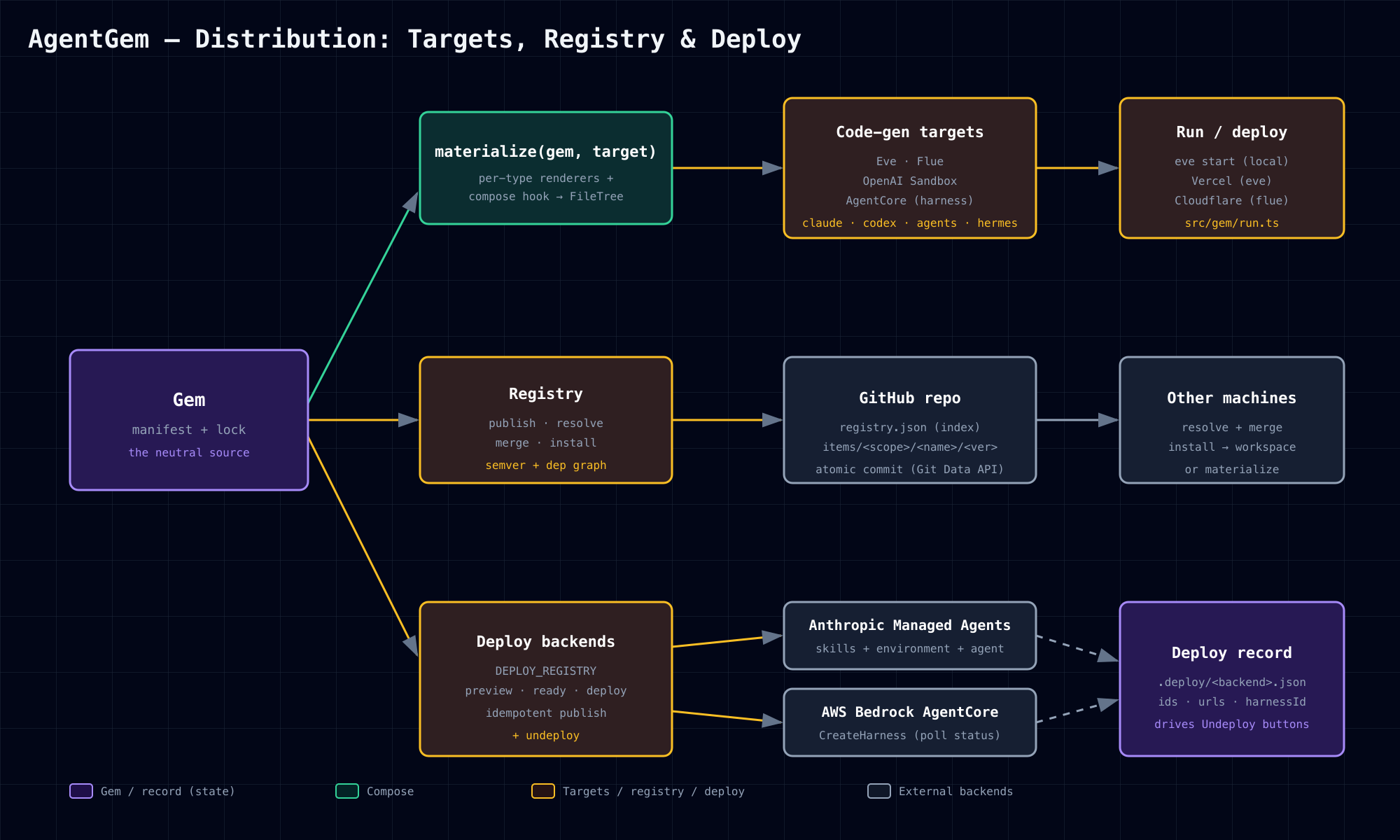
targets.ts) —materialize(gem, target)runs per-artifact renderers and a cross-cuttingcomposehook to emit aFileTree. Code-gen targets: Eve, Flue, OpenAI Sandbox, AgentCore (plus the editor targets claude/codex/agents/hermes). See Targets & deploy. - Registry (
registry.ts,registryGithub.ts) — a GitHub-backed index plus per-version item archives; publish / resolve / merge / install with semver and a dependency graph. See Registry. - Deploy backends (
deploy.ts,publish.ts,agentcorePublish.ts) — Anthropic Managed Agents and AWS Bedrock AgentCore, each recorded in a deploy record that drives Undeploy. - Testbed & Run (
testbed.ts,run.ts) — install a Gem into a local.claude/.codex/.hermestestbed, or run/deploy a materialized project locally, to Vercel, or to Cloudflare. See Testbed & run.
Source layout
src/
  index.ts            # AgentBack wiring: REST + MCP + Explorer on one app
  gem.controller.ts   # REST surface (@api) — /api/*
  gem.tools.ts        # MCP surface (@mcpServer) — /mcp
  schemas.ts          # Zod schemas shared by both surfaces
  resolveDir.ts       # config-dir + ~/.agentgem home resolution
  pickFolder.ts       # OS-native folder picker (for the UI)
  publish.ts          # Anthropic Managed Agents publish/undeploy client
  public/index.html   # single-page Gem Builder UI
  gem/                # framework-agnostic core (pipeline, targets, registry, run, …)
docs/
  diagrams/           # .svg (for docs), .png (fallback), .html (interactive export)
Where to go next
- The build pipeline — introspect → redact → buildGem → archive
- Archive format — the manifest + lock spec
- Redaction — the trust boundary and its rules
- API reference — every REST endpoint and MCP tool
- Targets & deploy · Registry · Testbed & run
- Development — build, test, and contribute