The build pipeline
A Gem is produced by four pure functions in src/gem/, chained from raw config to a
verifiable archive. This page traces that path. The safety rule that runs through it lives
in Redaction; the on-disk result is specified in
Archive format.
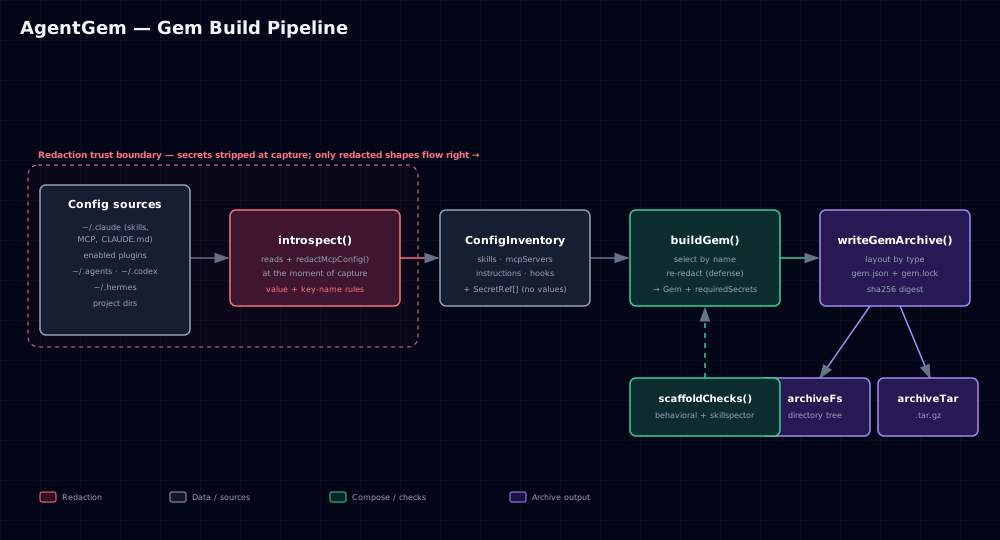
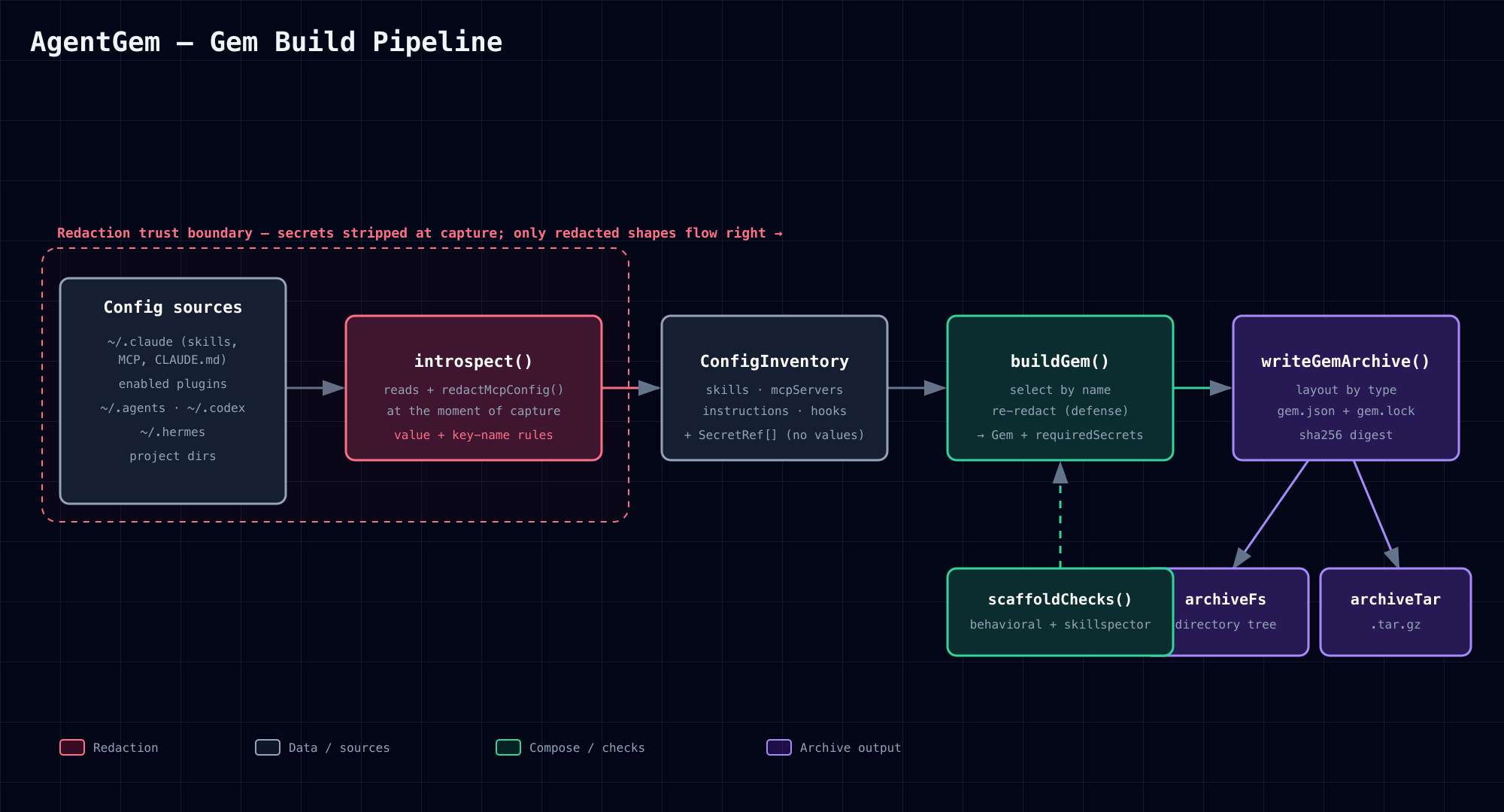
Diagram:
diagrams/gem-pipeline.svg· PNG · interactive HTML
1. Introspect — read config into an inventory
introspectConfig(opts) reads global config; introspectProject(root) reads a project's
config. Sources include ~/.claude (skills, MCP servers from settings.json / .mcp.json,
CLAUDE.md), enabled plugins, ~/.agents/skills, ~/.codex, and ~/.hermes. The REST and
MCP layers call introspectAll, which merges the global inventory with any selected project
inventories.
resolveDirs(dir?) derives all discovery roots from a single base, so a test (or a
?dir= override) can point the whole introspection at a fake home and stay self-contained.
The output is a ConfigInventory:
interface ConfigInventory {
  skills: SkillArtifact[];
  mcpServers: McpServerArtifact[];
  instructions: InstructionsArtifact[];
  hooks: HookArtifact[];
  projects?: ProjectInventory[];
}
Redaction happens here, at capture — introspect calls redactMcpConfig while reading,
so the inventory already carries <redacted> in place of secret values, plus a
secretRefs: SecretRef[] list of what was stripped and where.
2. Redact — strip secrets, record references
redactMcpConfig(config) returns { config, secrets }: the structure is preserved, secret
values become "<redacted>", and each strip is recorded as a SecretRef { name, location }.
The rules (key-name regex + value entropy + env/headers defaults) are detailed in
Redaction. This step is the reason every downstream consumer is secret-safe
by construction.
3. buildGem — select into a Gem
buildGem(inventory, selection, opts?) turns an inventory plus a selection into a Gem:
type GemSelection =
  | { all: true }
  | { all?: false; skills?: string[]; mcpServers?: string[];
      includeInstructions?: boolean; hooks?: string[];
      projects?: Record<string, ProjectSelection> };
It:
- validates every named artifact exists (throws on unknown names);
- collects the selected artifacts;
- re-redacts any MCP/hook artifact that arrives without
secretRefs— defense in depth, so a Gem can never be built from un-redacted input; - aggregates a
SecretRequirement[]({ name, artifact, location }) describing the secret surface by name only — never values; - redacts any operator-provided checks before embedding them.
The result:
interface Gem {
  name: string;
  createdFrom: string;
  artifacts: GemArtifact[];
  checks: GemCheck[];                  // 0..n embedded checks
  requiredSecrets: SecretRequirement[]; // declared surface; names only
}
Checks (optional)
scaffoldChecks(gem) drafts a smoke-test behavioral check (a task + deterministic
assertions, optional LLM judge) and, when the Gem has skills, an external check that runs
the skillspector security scanner. Checks travel inside the Gem and are themselves redacted.
See types.ts for BehavioralCheck, ExternalCheck, EvalAssertion, and EvalJudge.
4. Archive — lay out, hash, serialize
writeGemArchive(gem, opts?) lays artifacts out by type and writes the manifest + lock:
skills/<name>/SKILL.md
mcp/<name>.json            { transport, config, source?, secretRefs? }
hooks/<name>.json          { event, matcher?, config, source?, secretRefs? }
instructions/<name>.md
checks/<name>.json
gem.json                   # manifest — the human-meaningful index
gem.lock                   # lock — file hashes + gemDigest (sha256)
computeLock hashes every file (the manifest via canonical stable JSON) and derives a
deterministic gemDigest; verifyLock checks integrity on read. The file tree is then
serialized two ways:
writeArchiveDir/readArchiveDir— a directory on disk;packTar/unpackTar— a deterministic gzipped tar (sorted paths, fixed mtime) for transport and registry storage.
Full details — field shapes, digest computation, and verification — are in Archive format.
From the outside
Via REST (POST /api/gem) or the MCP build_gem tool, the whole pipeline runs behind one
call: introspect the requested dirs, build from the selection, return a redacted Gem.
POST /api/archive adds the manifest + lock and (optionally) a .tar.gz. See the
API reference.